Amazing 5- year old genius Mozart. She is blind and adopted by a couple who discovered her talent at the age of 3 playing piano from just hearing her mother sings. Her only teacher is just a home PC where she plays only by hearing it.
I had teary eyes every single time watches this clip. She is so tiny and fragile but with a giant talent that nobody can ever questioned. It was such a cliche for her bioligical parents to abandoned this precious jewel.
GOD bless this preciuos.
Friday, March 21, 2008


Thursday, March 20, 2008
Vinyl Gets Its Groove Back

From Time
From college dorm rooms to high school sleepovers, an all-but-extinct music medium has been showing up lately. And we don't mean CDs. Vinyl records, especially the full-length LPs that helped define the golden era of rock in the 1960s and '70s, are suddenly cool again. Some of the new fans are baby boomers nostalgic for their youth. But to the surprise and delight of music executives, increasing numbers of the iPod generation are also purchasing turntables (or dusting off Dad's), buying long-playing vinyl records and giving them a spin.
Like the comeback of Puma sneakers or vintage T shirts, vinyl's resurgence has benefited from its retro-rock aura. Many young listeners discovered LPs after they rifled through their parents' collections looking for oldies and found that they liked the warmer sound quality of records, the more elaborate album covers and liner notes that come with them, and the experience of putting one on and sharing it with friends, as opposed to plugging in some earbuds and listening alone. "Bad sound on an iPod has had an impact on a lot of people going back to vinyl," says David MacRunnel, a 15-year-old high school sophomore from Creve Coeur, Mo., who owns more than 1,000 records.
The music industry, hoping to find another revenue source that doesn't easily lend itself to illegal downloads, has happily jumped on the bandwagon. Contemporary artists like the Killers and Ryan Adams have begun issuing their new releases on vinyl in addition to the CD and MP3 formats. As an extra lure, many labels are including coupons for free audio downloads with their vinyl albums so that Generation Y music fans can get the best of both worlds: high-quality sound at home and iPod portability for the road. Also, vinyl's different shapes (hearts, triangles) and eye-catching designs (bright colors, sparkles) are created to appeal to a younger audience. While new records sell for about $14, used LPs go for as little as a penny--perfect for a teenager's budget--or as much as $2,400 for a collectible, autographed copy of Beck's Steve Threw Up.
Vinyl records are just a small scratch on the surface when it comes to total album sales--only about 0.2%, compared to 10% for digital downloads and 89.7% for CDs, according to Nielsen SoundScan--but these numbers may underrepresent the vinyl trend since they don't always include sales at smaller indie shops where vinyl does best. Still, 990,000 vinyl albums were sold in 2007, up 15.4% from the 858,000 units bought in 2006. Mike Dreese, CEO of Newbury Comics, a New England chain of independent music retailers that sells LPs and CDs, says his vinyl sales were up 37% last year, and Patrick Amory, general manager of indie label Matador Records, whose artists include Cat Power and the New Pornographers, claims, "We can't keep up with the demand."
Big players are starting to take notice too. "It's not a significant part of our business, but there is enough there for me to take someone and have half their time devoted to making vinyl a real business," says John Esposito, president and CEO of WEA Corp., the U.S. distribution company of Warner Music Group, which posted a 30% increase in LP sales last year. In October, Amazon.com introduced a vinyl-only store and increased its selection to 150,000 titles across 20 genres. Its biggest sellers? Alternative rock, followed by classic rock albums. "I'm not saying vinyl will become a mainstream format, just like gourmet eating is not going to take over from McDonald's," says Michael Fremer, senior contributing editor at Stereophile. "But there is a growing group of people who are going back to a high-resolution format." Here are some of the reasons they're doing it and why you might want to consider it:
Sound quality LPs generally exhibit a warmer, more nuanced sound than CDs and digital downloads. MP3 files tend to produce tinnier notes, especially if compressed into a lower-resolution format that pares down the sonic information. "Most things sound better on vinyl, even with the crackles and pops and hisses," says MacRunnel, the young Missouri record collector.
Album extras Large album covers with imaginative graphics, pullout photos (some even have full-size posters tucked in the sleeve) and liner notes are a big draw for young fans. "Alternative rock used to have 16-page booklets and album sleeves, but with iTunes there isn't anything collectible to show I own a piece of this artist," says Dreese of Newbury Comics. In a nod to modern technology, albums known as picture discs come with an image of the band or artist printed on the vinyl. "People who are used to CDs see the artwork and the colored vinyl, and they think it's really cool," says Jordan Yates, 15, a Nashville-based vinyl enthusiast. Some LP releases even come with bonus tracks not on the CD version, giving customers added value.
Social experience Crowding around a record player to listen to a new album with friends, discussing the foldout photos, even getting up to flip over a record makes vinyl a more socially interactive way to enjoy music. "As far as a communal experience, like with family and friends, it feels better to listen to vinyl," says Jason Bini, 24, a recent graduate of Fordham University. "It's definitely more social."
Wednesday, March 19, 2008
The Right Price for Digital Music- Why 99 cents per song is too much, and too little!?
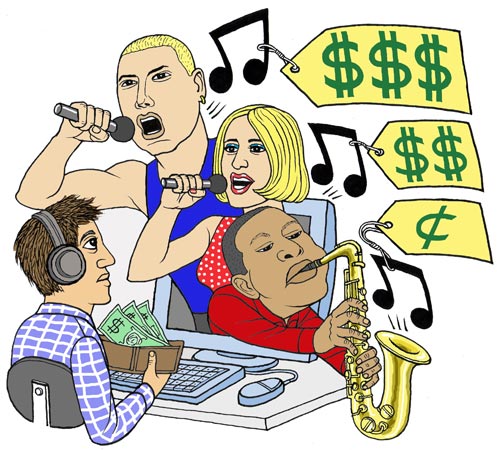
By Adam L. Penenberg
In the early 1900s, jazz musicians refused to record phonograph records because they feared rivals would cop their best licks. We can laugh at their shortsightedness, but it's reminiscent of today's music industry, which is so afraid of piracy it still hasn't figured out how to incorporate digital downloads into a sustainable business model. Each year record companies ship about 800 million compact discs—nearly 10 billion songs. That sounds like a lot until you compare it to the 13 billion songs that were available (according to download tracker BigChampagne) for free on peer-to-peer networks in 2004.
The one bright spot for the industry has been Apple's iTunes store, which has sold 600 million songs since 2003, accounting for 80 percent of legal downloads in the United States. Piracy is clearly here to stay, but as iTunes has shown, the record companies' best strategy is to provide an easy-to-use service that offers music downloads at a fair price. But what price is "fair"? Apple says it is 99 cents a song. Of this, Apple gets a sliver—4 cents—while the music publishers snag 8 cents and the record companies pocket most of the rest. Even though record companies earn more per track from downloads than CD sales, industry execs have been pushing for more. One option is a tiered pricing model, with the most popular tunes selling for as much as $3. After all, the music honchos reason, people pay up to $3 for cell-phone ring tones, mere snippets of songs.
Steve Jobs, who has been willing to take a few pennies per download so long as he sells bushels of iPods, calls tiered pricing "greedy." That view is shared by millions of consumers who believe the record companies have been gouging them for years. From the buyer's perspective, however, Apple's 99-cents-for-everything model isn't perfect. Isn't 99 cents too much to pay for music that appeals to just a few people?
What we need is a system that will continue to pack the corporate coffers yet be fair to music lovers. The solution: a real-time commodities market that combines aspects of Apple's iTunes, Nasdaq, the Chicago Mercantile Exchange, Priceline, and eBay.
Here's how it would work: Songs would be priced strictly on demand. The more people who download the latest Eminem single, the higher the price will go. The same is true in reverse—the fewer people who buy a song, the lower the price goes. Music prices would oscillate like stocks on Nasdaq, with the current cost pegged to up-to-the-second changes in the number of downloads. In essence, this is a pure free-market solution—the market alone would determine price.
Since millions of tunes sit on servers waiting to be downloaded, the vast majority of them quite obscure, sellers would benefit because it would create increased demand for music that would otherwise sit unpurchased. If a single climbed to $5, consumers couldn't complain that it costs too much, since they would be the ones driving up the price. And enthusiasts of low-selling genres would rejoice, since songs with limited appeal—John Coltrane Quartet pieces from the early 1960s, for example—would be priced far below 99 cents.
The technology for such a real-time music market already exists. The stock exchanges keep track of hundreds of millions of transactions every day and calculate each stock to the quarter-penny in real-time. Banks are able to do the same with hundreds of millions of ATM withdrawals. A music market would actually be much simpler. When a trader on the Chicago Mercantile Exchange buys soybean futures, he has to take into account weather, crop yields, supplies in other parts of the world, and the overall economy. On the Digital Music Exchange, there is only one input: demand.
The interface could look something like Apple's iTunes, where users search for songs they want. One important addition would be a ticker that calculates the number of times a track has been downloaded. Click on the icon to see how much it costs right now. Click again and you freeze the price—we'll give you something like 90 seconds to make up your mind—and make the purchase. If you buy a track for $1, that doesn't necessarily mean the price goes up for the next person. Just like on the stock market, it might take a lot of transactions to move the market. Another potential feature, stolen from Priceline: If you tell the system how much you're willing to pay for the new 50 Cent single—say, less than 50 cents—it could send you an e-mail alert when the market is willing to meet your price.
This is all really just a corollary to Chris Anderson's Long Tail theory. In the material world, stores sell goods that generate a satisfactory return on the space they eat up. According to Anderson, the editor in chief of Wired, your run-of-the-mill record store has to sell at least two copies of a CD per year to compensate for the half-inch of space it takes up on the shelf. But in the digital realm, there is no shelf space. Infinite amounts of product are available. Instead of a hit-driven culture, we experience what a friend of mine calls "an embarrassment of niches." A record company doesn't have to depend on one album to rack up sales of 5 million. They can make the same money selling 500 copies of 10,000 different titles, or, for that matter, 5 copies of 1 million titles.
Of course, there are modest fixed costs associated with this pricing model: bandwidth, servers, office space, electricity, and the salaries of people who maintain the business. That means there would have to be a price floor, perhaps 25 cents a song. But each obscure indie rock or klezmer song that gets sold for a quarter is almost pure profit, and the bargain-basement price would induce people to download even more tunes.
The big wild card here is the impact of illegal file sharing. David Blackburn, a doctoral student at Harvard, has argued that peer-to-peer systems increase demand for less popular recordings but dampen sales of hits. If that's the case, charging extra for top sellers might just push legal downloaders back into the outlaw world of peer-to-peer file trading. If that happens, perhaps the record companies will start offering free digital downloads of top-100 hits (with ads embedded inside, of course), while charging whatever the market will bear for the rest. A Digital Music Exchange may not be a perfect solution, but who would you prefer to set the price of music: consumers or record executives?
EMI to remain a member of IFPI
by IFPI
Leading record company EMI has announced it will remain a member of IFPI, the trade association that represents the recording industry worldwide.
IFPI represents more than 1,400 members in over 73 countries and works with affiliated national groups in 48 countries. Its mission is to promote the value of recorded music, safeguard the rights of record producers and expand the commercial uses of recorded music.
Jean-Francois Cecillon, President, EMI Music International Labels, said: "We undertook to work with our colleagues in the other major labels and with John Kennedy on a cost saving plan for the IFPI and together we have been able to find solutions which we believe are achievable whilst maintaining what the IFPI does best in representing our industry. I am glad to say that on the basis of those discussions we have been able to confirm our continued membership of the IFPI and we look forward to working with the IFPI on the crucial issues that our industry faces."
John Kennedy, Chairman and Chief Executive of IFPI, says: "I am delighted that EMI has decided to continue working with IFPI. It is extremely valuable for us to have their support in trying to address the many different challenges the recording industry is facing and addressing."
Leading record company EMI has announced it will remain a member of IFPI, the trade association that represents the recording industry worldwide.
IFPI represents more than 1,400 members in over 73 countries and works with affiliated national groups in 48 countries. Its mission is to promote the value of recorded music, safeguard the rights of record producers and expand the commercial uses of recorded music.
Jean-Francois Cecillon, President, EMI Music International Labels, said: "We undertook to work with our colleagues in the other major labels and with John Kennedy on a cost saving plan for the IFPI and together we have been able to find solutions which we believe are achievable whilst maintaining what the IFPI does best in representing our industry. I am glad to say that on the basis of those discussions we have been able to confirm our continued membership of the IFPI and we look forward to working with the IFPI on the crucial issues that our industry faces."
John Kennedy, Chairman and Chief Executive of IFPI, says: "I am delighted that EMI has decided to continue working with IFPI. It is extremely valuable for us to have their support in trying to address the many different challenges the recording industry is facing and addressing."
Sony BMG Drops DRM and Maybe Logic Too
News that Sony BMG would soon drop DRM encryption from their music library leaked but details were scarce. The company confirmed Monday the reports were accurate – more or less. It’s the “less” part that will cause some confusion.
Sony BMG will in fact begin selling unrestricted music January 15th. The method, however, won’t be as expected (at least initially). It might not make a lot of sense either. Instead of partnering with online music stores and offering their catalog in the portable unencrypted format, Sony BMG has opted to start their DRM-Free experiment by throwing their support behind traditional brick and mortar retailers: the bellwether’s of the labels’ past successes (Only about 10% of music sold in 2007 was online digital music).
Sony’s BMG has also opted to support only full album sales and not the more common online practice of ala carte singles with this first foray.
The new service is called the Platinum Music Pass. It is built around a gift card (called “Digital Album Cards”) that will unlock access to downloads on a new website. A Customer shopping at Best Buy, for example, can buy a Bob Dylan emblazoned card. When they get home, a scratch off section on the back will provide a unique product key. That key, in turn, will unlock a download of the Bob Dylan album from the website.
Retailers including Best Buy, Target, Trans World Stores (Coconuts, Wherehouse, FYE), and Winn Dixie will participate as sellers of the gift-cards to start. The album cards will be priced at $12.99, except in some cases where special edition packaging will push the cost to a premium. Some may be bundled with prizes and incentives including bonus content. A Canadian offering supported by Wal-Mart, HMV, Best Buy and other retailers is planned to roll out later this month.
Sony BMG’s US Sales President Thomas Hesse says: "We see MusicPass as a great way to bring digital music to the physical retail space. We believe it will have strong appeal for a broad range of consumers”
That belief seems suspect. At first glance, the service seems awkward and perhaps even ill conceived. For one thing, the nature of its sales process emphasizes a trip to a store to gain access to an online program. It’s inefficient to the point of being confusing. The concept may capture the occasional "impulse buy" but to a consumer actively seeking digital music it’s otherwise inconvenient. Why force them to a store? Instead of using technology to make a purchase easier, it adds a layer of additional tasks.
Additionally and even more troubling, this offer begs a form of channel conflict that calls into question the value proposition for a consumer. Ask this question: if a consumer goes to a store and decides to buy a full length album – what motivates him/her to buy the gift card over the CD? In both cases, having the music on a portable device will require a few steps at home. Pricing being similar why does he/she choose the card?
•With the card, there’s the music to download. Likely in a lower quality than the CD too. (Sony BMG hasn’t revealed the bit rate planned). Next there’s the need to distribute the music to the portable device. If there’s paranoia about computer crashes, there’s also a need to burn a backup CD so you don’t lose the music if your hard drive fails.
•With the CD, the buyer gets a tangible copy from the start. There’s no time lag, no waiting for a download. They can listen to it right away. And there’s less need for a backup. If the impetus for the purchase was to have the music in digital form: plop it into the computer and let iTunes (or equivalent) convert it to MP3. It’s simple enough. The software does the work. Why go another route?
Legality may be one answer but that’s a big debate nowhere near reaching a clear cut resolution. Legal minds are largely split as to whether ripping a CD you’ve purchased is a copyright violation. Some in the music industry, especially their lawyers, have suggested it is. Others, including an apparent majority of consumers, and their advocates, take the position that creating an MP3 from purchased music for personal use is perfectly legitimate under the doctrines of Fair Use. They further point out there’s no encryption to bypass on a CD (CD’s are unencrypted e.g. DRM-Free) so there’s no apparent Digital Millennium Act infractions either.
So if you set aside the legal debate and instead focus on what is already widespread consumer behavior (most music is still bought on CD’s and then converted to a digital format), is there another reason to opt for the card? If not, and none seem obvious, the value proposition is simple: for similar price, there is more value with the CD than one of these album cards. You get quality, durability, portability and options.
As a channel conflict, that points back to the same simple question: Why buy a card?
Sony BMG suggests it is partly because consumers like to buy gift cards. They cite an American Express study that claims nearly 25% of consumer gift spending will be directed toward gift cards. Trouble with that logic is that the majority of gift cards function same as cash within a store (online or in person). Platinum Music Pass isn’t a cash equivalent. It’s an album without the packaging and without the CD. What you buy is what you get, you just don’t get to take delivery until you get home and go through the authentication process. That means, Platinum Music Pass is not the same class as most gift cards.
Logically, the only way Platinum Plus seems to compute is from the vantage point of a retailer. In 2007, album sales fell approximately 15 percent while digital sales grew (Nielsen SoundScan). Brick and mortar stores lost business as digital rivals expanded. With those trends are only continuing, stores want solutions that save their lucrative revenue streams however experimental they might be. In that regard, the Music Pass program reads like an effort to support the retailers.
The paradox is it’s the consumer that’s supposed to always be right. It’s the consumer whose needs are supposed to be addressed. Music Pass cater’s to the sellers not the buyers. That, in turn, reeks of the same lack of customer awareness and sensitivity, the same kind of awkward effort to provide an ideal business solution at the expense of an ideal consumer one which has already plagued the music industry’s transition into the digital age.
Maybe, in fairness, judgment should be reserved until Sony BMG reveals the rest of their DRM-Free strategy. This thirty seven album experiment can’t be their entire vision. There’s just got to me more, something that makes sense. There has to be. Maybe the catalog will be licensed to Amazon’s MP3 Store soon, or iTunes…maybe they’ll try and revive the failed Sony Connect music store and make it home to a DRM-free catalog. There’s got to be something beyond Music Pass. Otherwise like Tom Hanks in Big, a lot of people should raise their hand and say, “I don’t get it.”
Some of the 37 Albums initially offered in this experimental format will include:
Alicia Keys, “As I Am.” Bob Dylan, “Dylan”. Brad Paisley, “5th Gear”. Britney Spears, “Blackout.”
Brooks & Dunn, “Cowboy Town.” Bruce Springsteen, “Magic.” Carrie Underwood, “Carnival Ride.” Daughtry, “Daughtry.” Elvis Presley, “Elvis 30 #1 Hits.” Jennifer Lopez, “Brave.” John Mayer, “Continuum.” Martina McBride, “Waking Up Laughing.” Santana, “Ultimate Santana.” The Fray, “How To Save A Life.” and Tony Bennett, “Duets”
Sony BMG will in fact begin selling unrestricted music January 15th. The method, however, won’t be as expected (at least initially). It might not make a lot of sense either. Instead of partnering with online music stores and offering their catalog in the portable unencrypted format, Sony BMG has opted to start their DRM-Free experiment by throwing their support behind traditional brick and mortar retailers: the bellwether’s of the labels’ past successes (Only about 10% of music sold in 2007 was online digital music).
Sony’s BMG has also opted to support only full album sales and not the more common online practice of ala carte singles with this first foray.
The new service is called the Platinum Music Pass. It is built around a gift card
 (called “Digital Album Cards”) that will unlock access to downloads on a new website. A Customer shopping at Best Buy, for example, can buy a Bob Dylan emblazoned card. When they get home, a scratch off section on the back will provide a unique product key. That key, in turn, will unlock a download of the Bob Dylan album from the website.
Retailers including Best Buy, Target, Trans World Stores (Coconuts, Wherehouse, FYE), and Winn Dixie will participate as sellers of the gift-cards to start. The album cards will be priced at $12.99, except in some cases where special edition packaging will push the cost to a premium. Some may be bundled with prizes and incentives including bonus content. A Canadian offering supported by Wal-Mart, HMV, Best Buy and other retailers is planned to roll out later this month.
Sony BMG’s US Sales President Thomas Hesse says: "We see MusicPass as a great way to bring digital music to the physical retail space. We believe it will have strong appeal for a broad range of consumers”
That belief seems suspect. At first glance, the service seems awkward and perhaps even ill conceived. For one thing, the nature of its sales process emphasizes a trip to a store to gain access to an online program. It’s inefficient to the point of being confusing. The concept may capture the occasional "impulse buy" but to a consumer actively seeking digital music it’s otherwise inconvenient. Why force them to a store? Instead of using technology to make a purchase easier, it adds a layer of additional tasks.
Additionally and even more troubling, this offer begs a form of channel conflict that calls into question the value proposition for a consumer. Ask this question: if a consumer goes to a store and decides to buy a full length album – what motivates him/her to buy the gift card over the CD? In both cases, having the music on a portable device will require a few steps at home. Pricing being similar why does he/she choose the card?
•With the card, there’s the music to download. Likely in a lower quality than the CD too. (Sony BMG hasn’t revealed the bit rate planned). Next there’s the need to distribute the music to the portable device. If there’s paranoia about computer crashes, there’s also a need to burn a backup CD so you don’t lose the music if your hard drive fails.
•With the CD, the buyer gets a tangible copy from the start. There’s no time lag, no waiting for a download. They can listen to it right away. And there’s less need for a backup. If the impetus for the purchase was to have the music in digital form: plop it into the computer and let iTunes (or equivalent) convert it to MP3. It’s simple enough. The software does the work. Why go another route?
Legality may be one answer but that’s a big debate nowhere near reaching a clear cut resolution. Legal minds are largely split as to whether ripping a CD you’ve purchased is a copyright violation. Some in the music industry, especially their lawyers, have suggested it is. Others, including an apparent majority of consumers, and their advocates, take the position that creating an MP3 from purchased music for personal use is perfectly legitimate under the doctrines of Fair Use. They further point out there’s no encryption to bypass on a CD (CD’s are unencrypted e.g. DRM-Free) so there’s no apparent Digital Millennium Act infractions either.
So if you set aside the legal debate and instead focus on what is already widespread consumer behavior (most music is still bought on CD’s and then converted to a digital format), is there another reason to opt for the card? If not, and none seem obvious, the value proposition is simple: for similar price, there is more value with the CD than one of these album cards. You get quality, durability, portability and options.
As a channel conflict, that points back to the same simple question: Why buy a card?
Sony BMG suggests it is partly because consumers like to buy gift cards. They cite an American Express study that claims nearly 25% of consumer gift spending will be directed toward gift cards. Trouble with that logic is that the majority of gift cards function same as cash within a store (online or in person). Platinum Music Pass isn’t a cash equivalent. It’s an album without the packaging and without the CD. What you buy is what you get, you just don’t get to take delivery until you get home and go through the authentication process. That means, Platinum Music Pass is not the same class as most gift cards.
Logically, the only way Platinum Plus seems to compute is from the vantage point of a retailer. In 2007, album sales fell approximately 15 percent while digital sales grew (Nielsen SoundScan). Brick and mortar stores lost business as digital rivals expanded. With those trends are only continuing, stores want solutions that save their lucrative revenue streams however experimental they might be. In that regard, the Music Pass program reads like an effort to support the retailers.
The paradox is it’s the consumer that’s supposed to always be right. It’s the consumer whose needs are supposed to be addressed. Music Pass cater’s to the sellers not the buyers. That, in turn, reeks of the same lack of customer awareness and sensitivity, the same kind of awkward effort to provide an ideal business solution at the expense of an ideal consumer one which has already plagued the music industry’s transition into the digital age.
Maybe, in fairness, judgment should be reserved until Sony BMG reveals the rest of their DRM-Free strategy. This thirty seven album experiment can’t be their entire vision. There’s just got to me more, something that makes sense. There has to be. Maybe the catalog will be licensed to Amazon’s MP3 Store soon, or iTunes…maybe they’ll try and revive the failed Sony Connect music store and make it home to a DRM-free catalog. There’s got to be something beyond Music Pass. Otherwise like Tom Hanks in Big, a lot of people should raise their hand and say, “I don’t get it.”
Some of the 37 Albums initially offered in this experimental format will include:
Alicia Keys, “As I Am.” Bob Dylan, “Dylan”. Brad Paisley, “5th Gear”. Britney Spears, “Blackout.”
Brooks & Dunn, “Cowboy Town.” Bruce Springsteen, “Magic.” Carrie Underwood, “Carnival Ride.” Daughtry, “Daughtry.” Elvis Presley, “Elvis 30 #1 Hits.” Jennifer Lopez, “Brave.” John Mayer, “Continuum.” Martina McBride, “Waking Up Laughing.” Santana, “Ultimate Santana.” The Fray, “How To Save A Life.” and Tony Bennett, “Duets”
Music Business Conference Dos & Don'ts

by Allan Johnston
Music Conferences today have become big business for the individuals and companies that put them on. Almost every conference created has an educational component, a seminar, panel discussion or technical workshop. Here lays the problem: Why pay good money to come to a conference with positive seminars and not attend? Every conference I have attended in the United States this year has had more nighttime attendees for parties and performances than daytime seminar attendees.
In Europe it is the complete opposite. Conference attendees come for business during the day in droves. Panels are packed and private meetings are scheduled. Let me give you a few ideas on how to become more productive at your next conference.
Rules To Work Conferences
1. Research Your Conference: Know who is going to be at the event you will be attending. Read the schedule in advance and determine who you want to meet and WHY you want to meet them.
2. Schedule Meetings: Try and reach companies, executives, publicists and other artists prior to the event and schedule private meeting times to discuss your MUTUAL interests. Email works when used properly for communication, so please spell correctly.
3. Speak Correctly: Leave the urban street-based conversations at home. This is a business and professionals will be attending and speaking on the seminars. Lose the phrase "You know what I mean?" and the phrase "You feel me?" Say what you mean upfront and be prepared to explain yourself. The way you speak in the "trap" is not going to get you anywhere in the entertainment BUSINESS environment.
4. Take a Shower: Partying the night before is NOT an excuse to have bad breath or body odor. Make the effort to bathe BEFORE you come to the seminar. You never know who you will be standing next to. By the way, dousing yourself in perfume or cologne is NOT bathing.
5. Be on Time, Awake, Attentive and Prepared: Walking into seminar fashionably late shows disrespect for the other attendees and to the seminar speakers. It also says that maybe a professional does not want to work with you because you didn't think enough of their time to hear them from the very beginning.
6. Take Notes: Just like you were back in school. This is how you remember some of the information that will be disseminated. Plus, this is how you can keep names and numbers straight while you write down any questions you may have.
7. Have Business Cards Available: Name, email, website, phone number, mailing address and a representation of what you do. (logo, business name, etc)
8. Receive Business Cards: When you give a card, receive a card. Take the card in both of your hands if possible; read it before you put it away. This business card is the beginning of your entertainment industry database, treat it with esteem.
9. Carry a Camera: Take photos of the panelists to help you remember who was who. And take as many photos with other people as you can. Email them back to the person and use this as a starting point for a great business relationship.
10. Be Polite and Courteous: You want and need to advance your career, the worst thing you can do is to disrespect and upset a professional. This means NOT telling a DJ off for not playing your music. DJ's TALK TO EACH OTHER and so do distributors, store buyers, publicists, record exec's, club owners and almost everyone else who is a professional.
11. Follow Up: Email, telephone, regular mail and do ALL of these things consistently. It is true that the squeaky wheel gets the oil.
12. Have an Online Presentation: MySpace is good for starters however you do need your own website that allows viewers to find out more about you and your talent. You should also create MP3s of your material for sending and for downloading. If you have a visual talent, create video for web usage.
Tuesday, March 18, 2008
5 Tricks Promoting Your Music Online
The Internet is a whole new world of promotional opportunities. Essentially everything you thought you knew about the business can be thrown out the window when you log into MySpace or any of a dozen other social networks to find new fans. Those bands that fail to make the essential adjustment are doomed to fail until they realize just how different everything is. For the rest of you, here are 5 essential tips that help you look beyond the basics of Music Marketing to find what you can really accomplish online.
Be a Fan
As a musician, your goals have been to spread your music, find new fans and build new audiences. You want to land gigs, sell CDs, and hopefully attract the attention of a major label. Sure, you still listen to other peoples’ music, but do you take the time to get truly invested in it like you once did. Probably not. To be successful online, you have to be a fan like you once were. Write reviews of albums, contact other bands and share experiences and cross promote until you can’t see straight anymore. The Internet is the very definition of a network. Market to it in that manner to take advantage of how interconnected everyone is.
Simplify
It’s a misconception that you need the biggest, flashiest, most powerful website on the planet to be seen by potential fans. In fact, as the Internet has matured, the desire for fancy, flash-filled websites has reversed. It’s the reason Facebook has become so popular in recent months - it is clean and straightforward. Break it down a bit - don’t overwhelm you visitors with videos, images, and applications. They take too long to load and ruin the whole experience.
Short and Sweet
They say you have about 3 seconds to capture the attention of a visitor and 10 more seconds to hold it. You have even less time as a band on MySpace. After all, there are a few million other bands to choose from and they all have their own messages. So, make yours quick, sweet, and to the point. Don’t give a bunch of facts about your music - be clever and pounce on the sensibilities of your listeners. If you know what they want - humor, philosophy, politics, anger - and give it to them, they will read more.
Be a Buddy
Talk to your fans. It might take time, and it might be downright mindnumbing to repeat the same answers you’ve given a few hundred times, but those listeners make you who you are. Create a blog, respond to comments and hold conversations. Humanize yourselves to the point that your fans will keep coming back to see what you have to say next.
Get Viral
It’s a familiar phrase and there’s good reason for it - everyone uses viral marketing these days. Remember that band with the treadmill music video? That video got more than 26 million views and was named one of the videos of the year by a dozen different news outlets for 2006! Guess what? The band made the video on their own - without approval or support from their label, and it helped them go platinum in record sales. It was a genius marketing ploy and has since been duplicated by dozens of different bands on YouTube, MySpace TV, and a dozen other sites. Think outside the box and try to develop something that will spread like wild fire.
If you build the right toolbox of new ideas and fresh approaches, even the convoluted world of Internet marketing can result in amazing returns for your band and its music.
Be a Fan
As a musician, your goals have been to spread your music, find new fans and build new audiences. You want to land gigs, sell CDs, and hopefully attract the attention of a major label. Sure, you still listen to other peoples’ music, but do you take the time to get truly invested in it like you once did. Probably not. To be successful online, you have to be a fan like you once were. Write reviews of albums, contact other bands and share experiences and cross promote until you can’t see straight anymore. The Internet is the very definition of a network. Market to it in that manner to take advantage of how interconnected everyone is.
Simplify
It’s a misconception that you need the biggest, flashiest, most powerful website on the planet to be seen by potential fans. In fact, as the Internet has matured, the desire for fancy, flash-filled websites has reversed. It’s the reason Facebook has become so popular in recent months - it is clean and straightforward. Break it down a bit - don’t overwhelm you visitors with videos, images, and applications. They take too long to load and ruin the whole experience.
Short and Sweet
They say you have about 3 seconds to capture the attention of a visitor and 10 more seconds to hold it. You have even less time as a band on MySpace. After all, there are a few million other bands to choose from and they all have their own messages. So, make yours quick, sweet, and to the point. Don’t give a bunch of facts about your music - be clever and pounce on the sensibilities of your listeners. If you know what they want - humor, philosophy, politics, anger - and give it to them, they will read more.
Be a Buddy
Talk to your fans. It might take time, and it might be downright mindnumbing to repeat the same answers you’ve given a few hundred times, but those listeners make you who you are. Create a blog, respond to comments and hold conversations. Humanize yourselves to the point that your fans will keep coming back to see what you have to say next.
Get Viral
It’s a familiar phrase and there’s good reason for it - everyone uses viral marketing these days. Remember that band with the treadmill music video? That video got more than 26 million views and was named one of the videos of the year by a dozen different news outlets for 2006! Guess what? The band made the video on their own - without approval or support from their label, and it helped them go platinum in record sales. It was a genius marketing ploy and has since been duplicated by dozens of different bands on YouTube, MySpace TV, and a dozen other sites. Think outside the box and try to develop something that will spread like wild fire.
If you build the right toolbox of new ideas and fresh approaches, even the convoluted world of Internet marketing can result in amazing returns for your band and its music.
Guide To Radio Promotion - Radio Promotion Basics

By The Music Connect
Radio is becoming more and more important in an artists career, but steady radio play is becoming harder and harder to obtain. The best way for an artist to get radio play that people are listening to is satellite radio via XM or Sirius. This form of radio is more supportive and accepting of independent and unsigned artists.
When starting your radio campaign most artists should start at a local level by contacting there local stations and see if they have a show for local artists, which many stations do. Make sure you post the station's request information on your website and have all of your fans request this song. This will get the stations attention. Even if they were not going to play your music, they may now take a second look after they see you have a fan base in the area.
The new step in your promotion of your song towards radio is pressing up copies of the single. There are many places that will thermal print your CDs and put them in jewel cases. You should not pay more then 55 cents a unit for this.
The next step is sending this song to your local radio stations again, all of the stations pertaining to your genre in your region, XM and Sirius, as well as any internet radio stations.
Radio promotion can be very time consuming and frustrating, and for many artists, a waste of time. You have to know when it is right to take your band to the next level by pursuing radio plays. This should come at a time when you have a fan base and have done a consistent amount of shows in your region. The radio play should accompany an album release. If it doesn't, many stations will not even think about playing your song unless you have a release coming out that has distribution where the radio station's signals reach.
Once you do start receiving some radio play contact the stations to see if you can do a "phoner" (an interview on their station via phone). Many of these phoner interviews are recorded and played on air at a later date, while a few are actually live.
Many artists wonder whom to contact at the radio station. The person you should be directing all of your music and information to is the program director. You should also give your music to popular DJs at the station you are targeting as they do have a very small bit of input on what is added to rotation, and some might help by giving your album a mention during their show.
You can employ a radio promotions company, but this will not be cheap. I do not recommend hiring a radio promotions company for an unsigned artist or an independent artist with a small budget because the failure rate of these campaigns is very high and many singles. And, artists are broken on radio with little or no money invested at all. Wait until you get a substantial budget to use a company that promotes to radio.
Before you start your radio campaign you should have the following checklist with all of the boxes checked:
* A budget of at least $1,000 USD for printing of CDs, mailing, mailing supplies, and other costs you may incur.
* A fanbase of many people who check your website and buy your CDs regularly. If no one at all is buying your CDs, then what makes you think they want to hear you on the radio?
* A song of yours that many people have listened to and they all feel it has the potential to become a hit. Even run it by your local radio station to get their feedback.
* Make sure you have a release, tour, or many shows coming up so the promotion on radio is worth it. So many artists attack radio with everything they have trying to get a major deal, and it doesn't work out and the money they spent is not recouped. Don't always shoot for a record deal. Work on selling your albums and growing a fanbase and the fame and money will come.
Music Publishing
by Allan Johnson
Before the invention of the phonograph, songwriters earned income by relying on music publishers to sell sheet music and piano rolls of their songs. Even as radio and television replaced the piano in the parlor, music publishers continued to play an important role as popular singers continued to rely upon established songwriters to provide their material. (Tin Pan Alley) However, with the advent of R&B (and especially the Motown era) popular recording artists began to write more of their own songs. Since that time, the music publishing industry has taken on a less important role for singers and a much more important role for revenue growth.
Publishers traditionally acquired revenue through several different means.
Performance Rights: A copyright owner has the exclusive right to authorize the "public performance" of that work. This is why radio and television broadcasters must enter into licenses with performance rights organizations such as BMI, ASCAP and SESAC. These performance rights organizations collect income on behalf of songwriters and music publishers whenever a song is publicly broadcast.
Synchronization Rights: Whenever a song is used with a visual image, it is necessary to obtain a "synchronization" (or "synch") license permitting the use of that song. Music publishers issue synch licenses to television advertisers, motion picture companies, video manufacturers and CD-Rom companies. A portion of this money (usually 1/2 the net proceeds) is paid to the songwriter.
Mechanical Rights: Mechanical royalties" refers to royalties paid for the reproduction of songs on CD, DVD, jump drives, DAT, audiocassette, flexi-discs, musical greeting cards, and other devices sold on a "per unit" basis.
However in today¹s new music business model publishers have begun to adjust their business practices to the new digital paradigm. The two main areas that are seeing significant growth are:
1. Wireless Broadband which is allowing the acceleration of device convergence. Now the iPhone has the capabilities of a computer, a PDA can be a music player and video game consoles can now access the Internet.
2. Mobile phones have become basic mini-PC¹s and there are over 3 Billion mobile phone users in comparison to only 1 Billion internet users.
What is happening worldwide is that the idea of ³selling copies² of music (mechanical license) has become secondary to having access to music. The Internet has become a huge machine that is allowing individuals to have access to and copy music, movies and other forms of entertainment instead of buying physical copies. Wireless Broadband access is opening up huge international markets in South East Asia and Latin America and this new access is creating shifts in how publishers must do business.
Publishers can no longer wait for companies to pay them for mechanical rights or even synchronization rights. This is a model based on consumer usage and this model is dying. Publishers must act quickly to license their catalogs to emerging technologies first; in fact recorded music and publishing licensing should now MARRY and be marketed together.
A good publisher must be able to license his catalog for internet and live music performances, background music, printed and digital sheet music, ringtones, lyric services, on-demand services, flat rate revenue sharing and ALL types of synchronization deals.
Physical sales of CD¹s are declining quickly while more and more music users see music as a ³free service² to be traded among other users. Couple this idea with an emerging international high economic growth, a young population and massive mobile phone usage and you have a perfect case for conceiving a new publishing model.
Gerd Leonhard has spent over twenty-five years in the technology and entertainment industries, both in the U.S. as well as in Europe, and recently, in Asia. In 2005, Gerd co-authored the critically acclaimed book "The Future of Music" which has become a must-read for music industry professionals around the globe, and which is now available in German, Italian, and Japanese. Recently he presented the following statistics.
a. In the past 12 months over 300 MILLION people joined online communities that use music
b. About 75,000 different devices can play MP3 files
c. In 12 18 months, digital broadcasting with ³drag & drop² TV and radio stations will be widely available.
d. In the next 12 months high-capacity wireless devices such as the iPhone will be widely available.
The music business has changed into the licensing business; will you be a part of the new paradigm?
Before the invention of the phonograph, songwriters earned income by relying on music publishers to sell sheet music and piano rolls of their songs. Even as radio and television replaced the piano in the parlor, music publishers continued to play an important role as popular singers continued to rely upon established songwriters to provide their material. (Tin Pan Alley) However, with the advent of R&B (and especially the Motown era) popular recording artists began to write more of their own songs. Since that time, the music publishing industry has taken on a less important role for singers and a much more important role for revenue growth.
Publishers traditionally acquired revenue through several different means.
Performance Rights: A copyright owner has the exclusive right to authorize the "public performance" of that work. This is why radio and television broadcasters must enter into licenses with performance rights organizations such as BMI, ASCAP and SESAC. These performance rights organizations collect income on behalf of songwriters and music publishers whenever a song is publicly broadcast.
Synchronization Rights: Whenever a song is used with a visual image, it is necessary to obtain a "synchronization" (or "synch") license permitting the use of that song. Music publishers issue synch licenses to television advertisers, motion picture companies, video manufacturers and CD-Rom companies. A portion of this money (usually 1/2 the net proceeds) is paid to the songwriter.
Mechanical Rights: Mechanical royalties" refers to royalties paid for the reproduction of songs on CD, DVD, jump drives, DAT, audiocassette, flexi-discs, musical greeting cards, and other devices sold on a "per unit" basis.
However in today¹s new music business model publishers have begun to adjust their business practices to the new digital paradigm. The two main areas that are seeing significant growth are:
1. Wireless Broadband which is allowing the acceleration of device convergence. Now the iPhone has the capabilities of a computer, a PDA can be a music player and video game consoles can now access the Internet.
2. Mobile phones have become basic mini-PC¹s and there are over 3 Billion mobile phone users in comparison to only 1 Billion internet users.
What is happening worldwide is that the idea of ³selling copies² of music (mechanical license) has become secondary to having access to music. The Internet has become a huge machine that is allowing individuals to have access to and copy music, movies and other forms of entertainment instead of buying physical copies. Wireless Broadband access is opening up huge international markets in South East Asia and Latin America and this new access is creating shifts in how publishers must do business.
Publishers can no longer wait for companies to pay them for mechanical rights or even synchronization rights. This is a model based on consumer usage and this model is dying. Publishers must act quickly to license their catalogs to emerging technologies first; in fact recorded music and publishing licensing should now MARRY and be marketed together.
A good publisher must be able to license his catalog for internet and live music performances, background music, printed and digital sheet music, ringtones, lyric services, on-demand services, flat rate revenue sharing and ALL types of synchronization deals.
Physical sales of CD¹s are declining quickly while more and more music users see music as a ³free service² to be traded among other users. Couple this idea with an emerging international high economic growth, a young population and massive mobile phone usage and you have a perfect case for conceiving a new publishing model.
Gerd Leonhard has spent over twenty-five years in the technology and entertainment industries, both in the U.S. as well as in Europe, and recently, in Asia. In 2005, Gerd co-authored the critically acclaimed book "The Future of Music" which has become a must-read for music industry professionals around the globe, and which is now available in German, Italian, and Japanese. Recently he presented the following statistics.
a. In the past 12 months over 300 MILLION people joined online communities that use music
b. About 75,000 different devices can play MP3 files
c. In 12 18 months, digital broadcasting with ³drag & drop² TV and radio stations will be widely available.
d. In the next 12 months high-capacity wireless devices such as the iPhone will be widely available.
The music business has changed into the licensing business; will you be a part of the new paradigm?
Why You Should Have Free Music on Your Website
It's human nature. Everyone loves getting something for free. Musicians and record labels can use this behavioral truth to increase traffic to their websites and generate qualified leads.
Not everyone who visits a website is ready to make a purchase. In many cases, people are just browsing. So even if the website is the main portal through which customers buy your music (or other merchandise), an equally important purpose of the website is to generate leads.
Creating an ezine or newsletter is a common "freebie." It certainly works on this site.
Subscribers opt in, which means they provide minimal personal information in order to receive the newsletter. Each new subscriber becomes another lead. The result over time is a large mailing list of qualified prospects. In addition to the newsletter, business owners email announcements of new products or services to this custom-made pool of potential buyers.
But you're a musician or doing something involving the music business, right? If you have music you can give away, that may be even more powerful to get people to sign up for your mailing list.
Another benefit of offering "freebies" is the valuable market information it will provide for you. A significant response to an offer suggests the item is a hot topic among qualified buyers. Such data can be useful in driving new product development for the business. Remixes, live recordings, etc.
Marketing experts have noted one downside of the free offer, the possibility of attracting people who solely want the "freebie" but are not interested in purchasing anything in the future. One way to decrease the likelihood of this is to make the free offer enticing to those in the market for the products and services offered for sale, but unappealing to others. A direct seller, for example, could offer a free item to anyone who buys a t-shirt (or other merchandise).
But it's just a download with no physical cost, so who cares? Give it away and don't worry about it.
A growing internet trend is to offer visitors a free membership to the website's online community. Membership entitles the user to access restricted areas of the site, publish a profile, and interact with other members of the community. Usually only a basic amount of information is required to join, such as name and email address.
This is great for acts with an already established following. Have a section where fans can interact, trade recordings, share photos from gigs, etc.
Industry estimates show that response rates triple when a "freebie" is offered as incentive for prompt action, effectively lowering the business owner's cost per lead substantially. Even if the free gift increases the total expense of the campaign, the higher volume of qualified leads will result in higher sales volume, thus offsetting the additional expense.
But as I said above-- just give away a music download. It's more or less free for you to do that, so don't get caught up with what you're "losing." Think about what you're gaining by getting more people on your mailing list and more people signed up to your online community.
Not everyone who visits a website is ready to make a purchase. In many cases, people are just browsing. So even if the website is the main portal through which customers buy your music (or other merchandise), an equally important purpose of the website is to generate leads.
Creating an ezine or newsletter is a common "freebie." It certainly works on this site.
Subscribers opt in, which means they provide minimal personal information in order to receive the newsletter. Each new subscriber becomes another lead. The result over time is a large mailing list of qualified prospects. In addition to the newsletter, business owners email announcements of new products or services to this custom-made pool of potential buyers.
But you're a musician or doing something involving the music business, right? If you have music you can give away, that may be even more powerful to get people to sign up for your mailing list.
Another benefit of offering "freebies" is the valuable market information it will provide for you. A significant response to an offer suggests the item is a hot topic among qualified buyers. Such data can be useful in driving new product development for the business. Remixes, live recordings, etc.
Marketing experts have noted one downside of the free offer, the possibility of attracting people who solely want the "freebie" but are not interested in purchasing anything in the future. One way to decrease the likelihood of this is to make the free offer enticing to those in the market for the products and services offered for sale, but unappealing to others. A direct seller, for example, could offer a free item to anyone who buys a t-shirt (or other merchandise).
But it's just a download with no physical cost, so who cares? Give it away and don't worry about it.
A growing internet trend is to offer visitors a free membership to the website's online community. Membership entitles the user to access restricted areas of the site, publish a profile, and interact with other members of the community. Usually only a basic amount of information is required to join, such as name and email address.
This is great for acts with an already established following. Have a section where fans can interact, trade recordings, share photos from gigs, etc.
Industry estimates show that response rates triple when a "freebie" is offered as incentive for prompt action, effectively lowering the business owner's cost per lead substantially. Even if the free gift increases the total expense of the campaign, the higher volume of qualified leads will result in higher sales volume, thus offsetting the additional expense.
But as I said above-- just give away a music download. It's more or less free for you to do that, so don't get caught up with what you're "losing." Think about what you're gaining by getting more people on your mailing list and more people signed up to your online community.
Top 10 Ways Fans Find Music on the Internet

The Internet is so chock full of music in this day and age that you can literally find it just about anywhere. There are social networking sites devoted to music sharing, dozens of different personal radio station websites, and long listings of review and trend setting websites that people use to find and obtain music. With so many different methods and so many different bands, it is no wonder that people use this vast array of different tools to unlock their favorite new bands.
1. MySpace - The biggest and most obvious place to look is on MySpace, where almost every band ever created has a profile these days. If you don’t already have a MySpace profile, you are sorely behind the music marketing curve.
2. iLike - This music only social networking site combines the concepts behind Facebook and MySpace with a music-centric only approach that allows bands and fans to connect on all new levels. Read our more in depth review of iLike.com here.
3. MP3.com - This site has been around for a long time and still provides one of the biggest and most interactive networks of free and independent music for fans to explore.
4. Last.fm - This online radio site allows people to upload and share their playlists and favorite tracks with each other.
5. SoundClick - Another music social network that combines the friendly atmosphere of a social network with the playlist sharing and musical tastes of a music sharing site.
6. Emusic - A DRM free music site that allows indie artists to sell their tracks without the restrictive copyright requirements of services like iTunes.
7. Music Mesh - Allows you to sort through artist lists, search for tracks based on musical styles, and uncover reviews and playlists based on your preferences.
8. ShoutCast - A directory of many online radio stations that can be accessed and played through Winamp.
9. iJigg.com - A popular location for indie artists to upload and post their music, offering it for free to their fans to download.
10. Imeem - A playlist and track sharing website that users and artists can use to upload and imbed tracks onto other social networks that do not support music uploading or sharing.
Subscribe to:
Comments (Atom)
.jpg)

